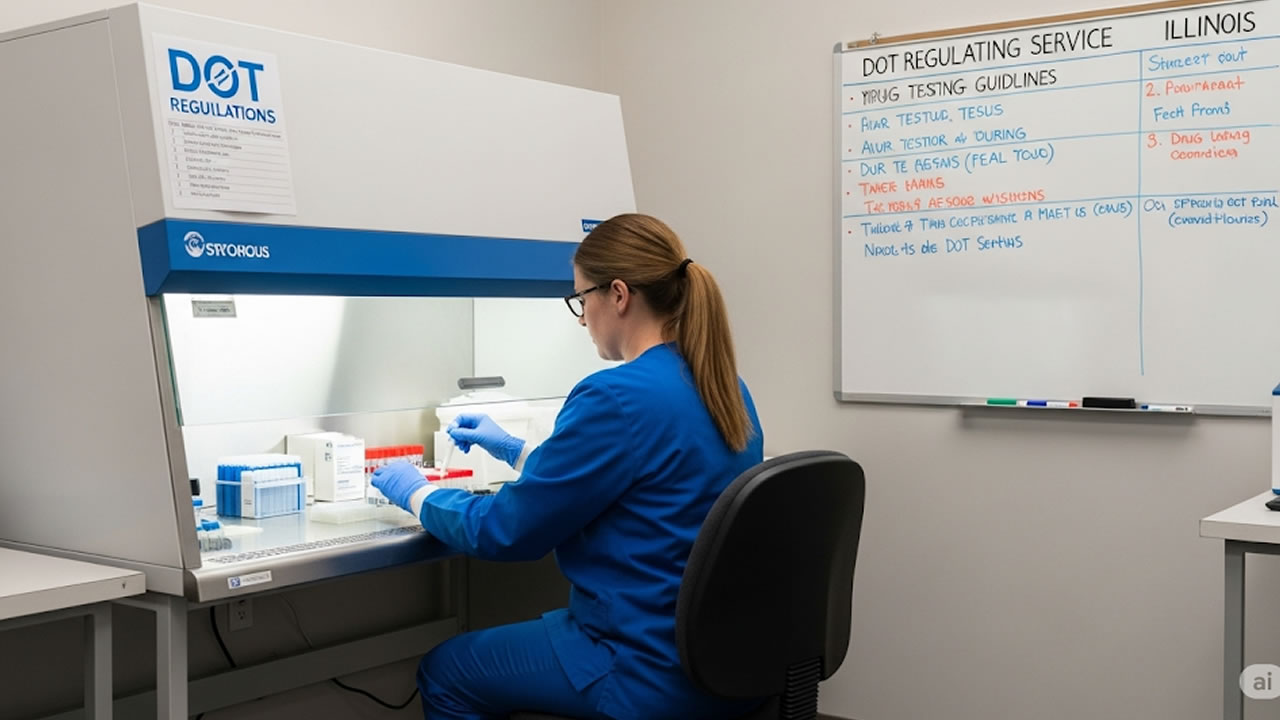
DOT Drug Testing in Illinois : Driving a commercial vehicle across this country entails more than just being good at driving. It requires a commercial driver to be more compliant, especially with the DOT drug testing regulations. Whether you are an owner-operator, a holder of a CDL, or even lead a fleet, you would want to remain in line with FMCSA drug and alcohol testing rules, thereby ensuring your safety and his career are on track. This guide simplifies what every truck driver from Illinois needs to learn about DOT drug testing, where to find certified centers nearest to you, and how to stay compliant.
What Is DOT Drug Testing in Illinois?
These tests are administered under the Department of Transportation’s drug-testing program in Illinois, which serves as a blanket safety requirement at the federal level to monitor the use of controlled substances by commercial operators of vehicles. In 49 CFR Part 40, it states that every person with a Commercial Driver’s License (CDL) must go through drug and alcohol tests just to qualify to drive with it.
Tests performed under the standard DOT drug test include:
Marijuana (THC)
Cocaine
Opiates (including codeine, morphine, heroin)
Amphetamines and Methamphetamines
Phencyclidine (PCP)
Positive tests or refusals by truck drivers must complete the DOT SAP Return-To-Duty Process before leaving the road.
Who is Subject to DOT Testing for Illicit Substances in Illinois?
The FMCSA regulates employees in Illinois driving commercially used vehicles with a gross vehicle weight rating (GVWR) of at least 26,001 lbs. or those vehicles carrying hazardous materials; the same are subject to the requirement for DOT drug and alcohol testing.
This includes:
Owner-operators
Company-employed CDL drivers
Fleet managers
School bus drivers
Interstate and intrastate truck drivers
Types of DOT Drug Testing Required from Truck Drivers
There are different types of DOT-required drug testing throughout the career of every CDL driver in Illinois:
1. Testing before appointment
A driver must submit to pre-employment drug testing before operating a commercial vehicle.
2. Random Testing
Truck drivers are selected for testing at random intervals throughout the year as a means of assuring safety.
3. Post-accident Testing
Any driver involved in an accident that results in injury and/or death or damage to property is immediately referred for DOT drug testing.
4. Reasonable Suspicion Testing
If a supervisor observes behavior suggesting the use of drugs or alcohol, a test can be required by the employer or a supervisor.
5. Return-to-Duty and Follow-Up Tests
Following a DOT violation, drivers are required to complete the SAP program and return-to-duty testing before resuming work.
DOT Drug Testing Centers in Illinois near Me
It is very easy to obtain a DOT drug testing center nearest to you in Illinois. So many FMCSA-certified collection sites are scattered across states and offer same-day testing, walk-ins, and after-hours services to truckers.
DOT Drug Testing Locations in Major Illinois Cities
Chicago, IL – DOT drug testing near me | CDL testing Chicago Loop
Aurora, IL – FMCSA drug testing near me | DOT physicals Aurora
Rockford, IL – DOT drug testing centers in Rockford
Joliet, IL – Truck driver drug testing near me in Joliet
Naperville, IL – DOT urine test for CDL drivers Naperville
Peoria, IL – Certified DOT drug test near me Peoria
Springfield, IL – CDL compliance testing centers Springfield
Elgin, IL – Same-day DOT test for drivers in Elgin
Waukegan, IL – FMCSA-compliant drug testing near me in Waukegan
Cicero, IL – DOT drug and alcohol testing centers near me in Cicero
Instant DOT drug test results, electronic chain-of-custody forms (eCCF), and reporting to the FMCSA Clearinghouse for full compliance are available with many test centres.
Why Compliance with DOT Drug Testing Matters in Illinois
Most importantly, it gives not just legal defences but also safety and confidence in the trucking industry.
Benefits of compliance:
Avoid FMCSA fines and suspension
Maintains active CDL
Protects employer’s CSA score
This will also save you from violations or disqualifications, many of which incur costly fines and more.
This may lead to license suspensions, civil penalties, and an SAP return-to-duty process.
How to Schedule a DOT Drug Test in Illinois
Truck drivers or fleet owners can schedule a DOT drug test near them through certified testing centres online or by phone. Most facilities offer walk-in DOT testing for convenience.
Steps to book a DOT test:
Locate an FMCSA-approved testing centre in your area
Bring a valid CDL license or driver ID
Complete the chain of custody form (CCF)
Undergo the urine test
Receive your MRO-verified results electronically
Cost of DOT Drug Testing in Illinois
Costs for a DOT drug test in Illinois average between $60-$90, depending on the location and added needs for testing. Bulk or fleet testing packages usually come with discounts for trucking companies managing multiple drivers.
DOT Drug Testing for Trucking Companies in Illinois
Compliance is everything if running a trucking business in Illinois. Joining one of those DOT consortiums or random testing programs is the way to go to stay compliant with FMCSA without risk of missing deadlines.
Some of the services that help keep an employer compliant are:
Management of a random testing pool
Development of an employee drug and alcohol policy
Reporting to FMCSA Clearinghouse
Training supervisors regarding reasonable suspicion
SAP return-to-duty coordination
Keep Compliant and Movement – DOT Drug Testing Illinois
All CDL drivers must follow DOT rules on drug and alcohol testing, whether in Chicago, Peoria, or Springfield. Certified testing centers near me in Illinois present convenient ways to schedule tests to comply with FMCSA requirements to keep your trucking career on the road and safe.
Disclaimer: The information provided in this blog post is for general informational purposes only. While we strive to keep the content accurate and up to date, we do not guarantee its completeness, reliability, or accuracy. Any actions you take based on this information are strictly at your own risk. We are not responsible for any losses, damages, or inconveniences that may arise from the use of this blog. For professional advice, please consult a qualified expert.